
Predictability of North Pacific Blocking Events : Analogue Based Analysis of Historical MIROC6 Simulations
Published in Quarterly Journal of the Royal Meteorological Society, 2026
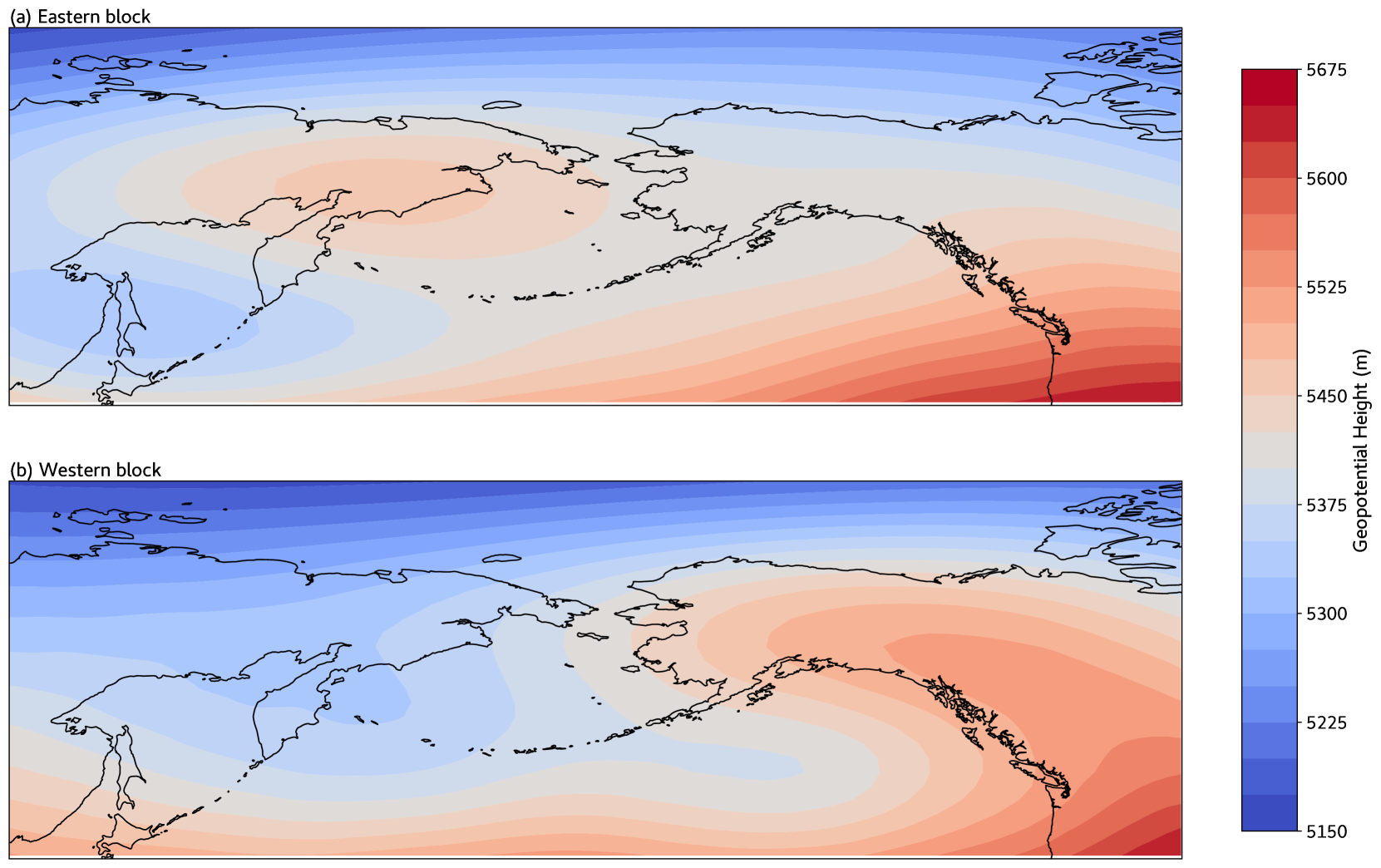
Atmospheric blocking exerts a profound influence on midlatitude circulation, yet its predictability remains elusive, due to intrinsic nonlinearities and sensitivity to initial conditions. While blocking dynamics have been extensively studied, the impact of geographical positioning on predictability remains largely unexplored. This study provides a comparative assessment of the predictability of western and eastern North Pacific blocking events, leveraging analogue-based diagnostics applied to Coupled Model Intercomparison Project Phase 6 (CMIP6) Model for Interdisciplinary Research on Climate, version 6 (MIROC6) simulations. Blocking structures are identified using geopotential height gradient reversal, with their temporal evolution analyzed through trajectory tracking and error growth metrics. Results reveal that eastern blocks exhibit lower predictability, characterized by rapid error divergence and increased mean logarithmic growth rates compared with western blocks. Persistence analysis gives no significant difference between eastern and western North Pacific blocking events. Sensitivity analyses across varying detection thresholds validate the robustness of these findings.
Download the paper here.
Recommended citation: Xavier, A. K., Hamilton, O., Feranda, D. & Vannitsem, S. (2026) Predictability of North Pacific Blocking Events : Analogue Based Analysis of Historical MIROC6 Simulations. QJRMS e70104. https://doi.org/10.1002/qj.70104